Our Nurse Home Visitors work alongside their clients to provide the best quality care using their nursing expertise, and connecting clients with our legal and professional partners, as well as resources within the clients’ own communities. Sometimes issues arise that have no clear solution, issues that are caused by systems-level barriers.
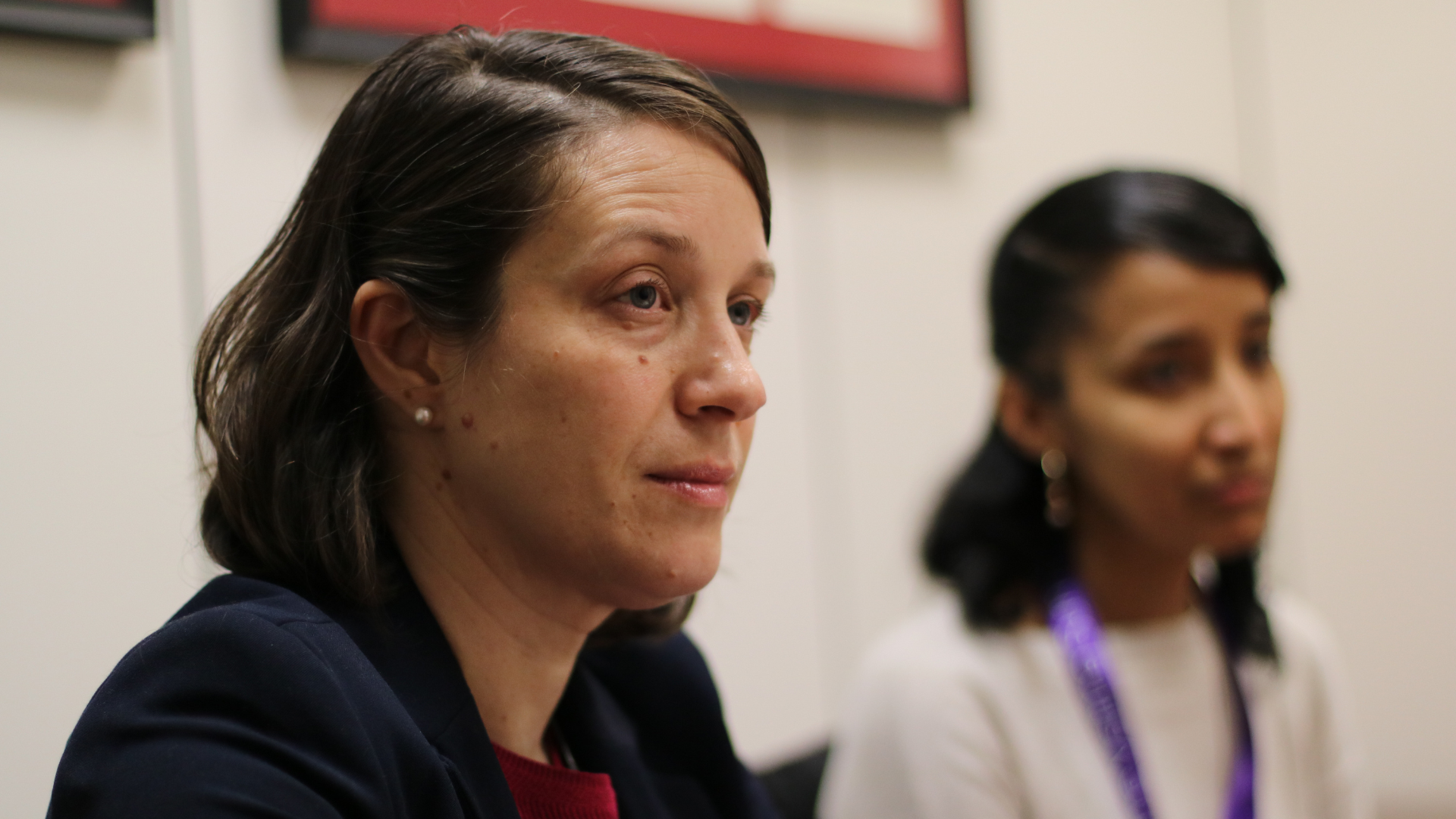
Joy Ahn, our Nurse Advocacy Manager, dedicates her time to systems-level change. She orients her work around the experiences of the home visiting nurses and clients to meaningfully inform public policy. At NNCC, she has created a system to collect client and nurse stories reflecting barriers to health and/or strategies to improve health and well-being.
As a former Nurse Home Visitor with our Philadelphia Nurse-Family Partnership program, Joy experienced first-hand the power of translating client experiences into advocacy. She shared her vision and method of systems-level advocacy at StartEarly's 2024 National Home Visiting Summit in Washington, D.C.
Using the development of the Coalition for Lactation-Friendly Schools as an example, Joy shared her advocacy method:
As a Nurse Home Visitor, Joy had numerous clients who were forced to choose between continuing their education and breastfeeding their child. One client was told by their principal that they were not allowed to pump milk in school. Another client was told their grades would be adversely affected if they were late to class due to pumping.
Joy found evidence that parents who continued to breast/chest-feed beyond six weeks reported significant emotional, informational, and instrumental support from family, friends, school, and their babies. (Wambach, et al, 2009).
Joy spent time researching states that supported students and their goals to continue lactation. At the time she first looked into it, there were two states with legislation supporting lactating students: Virginia and California. Since then, other states have joined that group, including Nebraska, Illinois, Maryland, and Arkansas.
Joy learned from her time with clients and her research that legislative advocacy was the best way forward. Opportunities for change started locally and continued at the state and federal level. The power reached the PA House of Representatives and advocates within the US Breastfeeding Committee.
After years of looking for an open window in related meetings, Joy was eventually connected with two other people interested in advocating for parenting students. The conversation grew from connections with the Food Trust and Women’s Law Project, to collaborating with Maternity Care Coalition, the Education Law Center, the Philadelphia Department of Public Health, the School District of Philadelphia, and others. Together, they formed the Coalition for Lactation-Friendly Schools.
The Coalition for Lactation-Friendly Schools’ advocacy took many forms. They spoke with local media and wrote an op-ed, educated the public and legislators at community events, created model legislation, informed Representative Isaacson’s bill in the PA House (2019, 2021, 2023), and were awarded Advocate of the Year 2020 by PRO-LC.
Joy and the Coalition for Lactation-Friendly Schools know that the work doesn’t end when a bill is introduced or even once passed. They continue to inform stakeholders and legislators, conduct surveys of current school lactation policies, and organize supporters through targeted outreach like sign-on letters. They continue to cultivate varied subject matter expertise through their affiliated organizations and identified a fiscal sponsor to facilitate external support for education and advocacy related to lactating students.
When systems-level barriers repeatedly prevented Joy from providing the best care to her clients, she recognized that she needed to advocate upstream. Joy stepped up to the challenge by collecting as much data and information as possible, identifying who holds the power to enact change, intentionally forming a powerful network of advocates, and making their voices heard throughout the state. This system of identifying and working to solve ‘puzzling policies’ is not a skill only Joy holds - anyone can be an advocate.
Joy, a public health nurse and change agent, envisions a country where everyone who works in public health realizes their power to share their knowledge from boots-on-the-ground work to impact positive change in their organizations, their towns, their states, and their country. She truly believes that anyone can be an advocate on any level - all it takes is a phone call. Your story matters, and your experience is important and valid. If you see something that is not working and think, ‘Someone should do something about that,’ that someone might just be YOU.

Dr. Erin Graham, DNP, APRN
The National Nurse-Led Care Consortium (NNCC) provides pregnant and parenting persons in Philadelphia with community public health services through two evidence-based home visiting programs: Philadelphia Nurse-Family Partnership (NFP) and Mabel Morris Family Home Visit Program (Parents-as-Teachers). Our nurses visit families regularly throughout pregnancy and the early years of parenting and help them build a healthy foundation of wellness and resources. While our nurses are a critical part of their families' healthcare team, we believe that, for some families, bridging the care being offered in the home to clinical care settings can further improve their overall health.
For this reason, NNCC partnered with PolicyLab at Children’s Hospital of Philadelphia to develop the Community Clinical Systems Integration (CCSI) initiative. CCSI is a model of care where our home-visiting nurses’ partner with CHOP primary care providers in assessing the needs of and supporting the health and development of each child. Facilitated by nurse access to their clients’ medical health records, the model improves communication between the pediatrician’s office and nurses and creates continuity of care that increases care team support and broader monitoring of the child’s health.
This shift in how the care team interacts across settings empowers families to recognize that they are an important piece in the decision-making process and increases their trust in health care. Dr. Erin Graham, DNP, APRN, NNCC’s Senior Director of Healthcare Integration who participates in the development of the CCSI initiative, described during the National Home Visiting Summit, what she felt was the greatest opportunity the initiative presents. This project is about finding effective ways to share information and creating less of a burden on all parties, home visitors, health care providers, and most importantly, families.” If we can prioritize the sharing of information as well as the individuals directly involved in the exchange of that information, we’re going to see overall satisfaction and engagement not only in families but also in providers and home visitors.

Anna Bechtel, MPH, BSN, RN
Anna Bechtel, MPH, BSN, RN has been an NFP nurse for five years and started working within the CCSI model two years ago. She shared a story during the Summit of a particular family that saw a big impact on their health. Their story is below, and the sections in bold highlight what CCSI made happen – and would not have happened without the permissions facilitated by CCSI. The names of the clients in the story were changed for patient privacy:
“When she was 8 months old, Jules was underweight and scoring behind on her gross and fine motor milestones. The family had been dealing with housing and food insecurity, and mom Denaya was under so much stress, that she hadn’t taken Jules to the pediatrician in the last 4 months of age. Denaya was worried about Jules’ weight but didn’t know what to do. I spoke to her more and found out that she had been trying to schedule a wellness visit but was having difficulty because she hadn’t shared what was going on with the pediatrician’s office.
With her permission, I emailed the pediatrician with the details of their situation and confirmed with the office that they would see her that same week. Afterwards, I read the note from their visit to see what the pediatrician had documented about their visit and then talked with Denaya to hear her interpretation of it. Based on the communication from the pediatrician, I then supported the family in getting the high-calorie formula they were prescribed from WIC, helped them get a new SNAP card, and set up a ride to the store to get the items they needed. I was also able to look at the chart and see that Jules was supposed to be getting physical therapy (PT) and occupational therapy (OT) but had missed several appointments. After reviewing the developmental assessment with Denaya and helping her understand more about her daughter’s needs, she was motivated to get Jules back to therapy and we arranged for transportation. Throughout this, I continued to follow up with weight checks with Jules and added those weights to her medical chart so the pediatrician's office could also be informed.
As the family continues to struggle with housing, I have followed them and have been able to keep in continuous contact. Jules is now 16 months old and hasn’t missed any more wellness visits. She has had the necessary surgery required for her care followed up with PT and OT and is now walking on her own. The family is in stable housing and has access to enough food. Throughout this, I was able to update their pediatrician on the progress they’ve been making in between wellness visits, so the care team is all on the same page.”
The CCSI program provided a space for Denaya’s nurse home visitor to work directly with her pediatrician and find the best way to support Denaya and her daughter, despite all the obstacles that stood in their way. With every step made toward Jules's care, the CCSI program reinforced Denaya’s understanding of the complex medical situation and empowered her to make educated decisions for her daughter and family. By working together, home visitors and primary care providers can best serve people like Denaya and their families

The US Department of Housing and Urban Development (HUD) states that the Fair Housing Act (FHA) prevents direct providers of housing from discriminating against persons due to race, color, religion, sex, national origin, familial status, or disability. The purpose of the act is to promote equity in housing opportunities that these identifying features could limit. When the act was first passed, in 1968, it was meant as a follow-up to the Civil Rights Act of 1964.1 Recently, in 2021, the federal government expanded enforcement of the FHA to include sexual orientation and gender identity. Some states, including Pennsylvania, also provide protections for individuals who are discriminated against for sexual orientation or gender identity, as do some municipalities. Despite these expansions, the FHA falls short - explore how here:
Though the FHA covers “family status” and “sex” as discrimination categories, it does not cover all family statuses, such as single parents. Family status is meant as a term to cover discrimination against families with children or persons who are pregnant. “Sex” had to be explicitly expanded in 2021 to include gender identity and sexual orientation, and HUD still has nothing listed under examples2 of discrimination against LGBTQ persons, while providing examples for all other categories. HUD does offer a separate guide for LGBTQ persons who are facing discrimination.3 Additionally, the law does not cover landlord-occupied buildings with four or fewer units, housing operated by religious groups or private clubs, and single-family homes directly sold or rented by the owner.4 In many areas, smaller rentals like these are the most accessible and affordable to marginalized groups.
Enforcement of the FHA requires a high level of legal literacy on the part of the wronged person. Knowledge of the laws, access to reporting methods, and time and resources to pursue justice are all required for the person to act. In many cases, the person may not even know they were wronged, as landlords may say things such as they “just rented the last apartment” or they’ll “let you know as soon as one is available,” or they charge fees they know will be prohibitive. Often, the search is so overwhelming that people lose track of where they’ve applied or assume that nothing is available if they don’t hear back.
Legislators in Pennsylvania have introduced bills to protect those searching for housing, especially those who’ve interacted with the justice system. Pennsylvania State Representative Donna Bullock proposed a bill in 2016 that would prevent landlords from asking about or requiring applicants to disclose some arrest records — such as juvenile records, arrests with no convictions, convictions other than felonies or misdemeanors, or convictions older than seven years — as a condition of housing. The bill was not passed then, but Bullock reintroduced the bill this April as House Bill 96.5 Conditions in the PA House look favorable for Fair Housing legislation, as the Pennsylvania House Housing and Community Development Committee unanimously advanced multiple Fair Housing-related bills in February 2024. A list of current legislation, as well as committee transcripts and reports, can be found here. The legislation also addresses affordable and accessible housing, often tied in the public’s mind to Fair Housing.
Federally, the Fair Housing Improvement Act of 2023, introduced by Senator Tim Caine of Virginia,6 would expand the Fair Housing Act to include discrimination based on source of income, veteran status, or military status. The proposed act is currently in the Committee on Banking, Housing, and Urban Affairs and is in hearings. If passed, the act would provide additional protection against discrimination to those receiving housing vouchers, rental assistance, and other subsidies from both government and private agencies, which are often disclosed during the housing application process.
Housing discrimination can be reported locally and federally. Federally, you can file a complaint online, by phone, or by mail at: https://www.hud.gov/fairhousing/fileacomplaint or 800-669-9777.
Locally, you can find your state’s fair housing assistance program here: https://www.hud.gov/program_offices/fair_housing_equal_opp/partners/FHAP/agencies
Private fair housing organizations also advocate on applicants’ behalf. A list of organizations by state can be found here: https://www.hud.gov/program_offices/fair_housing_equal_opp/contact_fhip
As the first month of what we hope will be a better year comes to a close, we’re looking back on how the challenges of our past and present are building a springboard for change going forward. NNCC works at the intersection at public health and primary care, connecting communities and health care providers, and sharing lessons learned “on the ground” to better inform policy and practice. In 2020, the nation was focused on survival and resiliency. Our nurses and practices adapted quickly, policies changed rapidly, and the outlook was dire. Although the change won’t be immediate, we have every reason to believe 2021 can be a year of healing and recovery. Emulating the role nurses play as the backbone of their health systems and communities, NNCC is aligning with advocates for public health and justice as we forecast areas where we hope to bring positive social change in 2021.
Since our nation's founding, structural racist violence has had devastating impacts on communities of color. In 2020, the effects of systemic racism reached renewed visibility, exacerbated by the global pandemic and accompanying recession, as well as continued police violence against Black Americans. The effects of this legacy of racist policies are especially striking in the healthcare setting, as people of color continue to suffer worse health outcomes than their white counterparts, limited access to care, and significantly higher rates of COVID-19 incidence and death. We are hopeful that 2021 will bring renewed focus on these crucial issues and innovative policy solutions to begin to dismantle racism embedded in the structure of our society.
The Biden administration has already begun to work towards this end, with an executive order designed to aid federal branches and programs to identify and remedy systemic racial barriers within their work. The administration has also created the COVID-19 Health Equity Task Force, which will be chaired by Dr. Marcella Nunez-Smith, to insure that all aspects of the federal pandemic response are formed with an equity lens. Dr. Nunez-Smith says her vision for the task force is a broad one, including "conversations about housing stability and food security and educational equity, and pathways to economic opportunities and promise."
In Congress, the Improving Social Determinants of Health Act (of which NNCC is an endorsing organization) was recently re-introduced for the new session by Congresswoman Nanette Diaz Barragán. The legislation would create a social determinants of health program to address non-medical factors in health outcomes, which are often driven by systemic inequalities.
While no single policy or piece of legislation can eradicate racism in our health system, we are optimistic about these and other efforts and remain committed to developing an anti-racist lens for all our advocacy work.
After a national victory in developing effective vaccines against COVID-19 within an unprecedented timeline, the vaccine rollout has faced numerous delays. The challenge of distributing the vaccine is twofold: the logistical hurdles of prioritization, equitable distribution, storage, and supply present difficulties alongside a need to build public trust in the safety and efficacy of the available vaccines. The newly announced Biden-Harris COVID relief proposal contains plans for a robust, $20 billion national vaccination program. Recognizing the importance of Community Health Centers (CHCs) to public health, President Biden's vaccination plan includes partnering CHCs with mobile clinics to expand vaccine distribution.
Without a sufficient percentage of the population vaccinated against COVID, the disease will continue to spread. From growing fringe movements spreading misinformation about vaccine safety to justified distrust among Black communities who have long experienced medical racism at the hands of the government and other entities, building public confidence in the safety and effectiveness of the COVID vaccines will be a public health policy priority in 2021. NNCC has joined the COVID-19 Vaccine Education and Equity Project to promote the impact of the vaccine and provide education on the benefits of getting vaccinated.
According to a 2020 report from the Commonwealth Fund, the United States has the highest maternal mortality ration among wealthy countries even when the data is limited to just white birthing parents. For women of color, especially Black women, the picture is much more dire. The same report shows data that the maternal mortality rate for Black mothers was 2.5 times greater than for white mothers, the same gap that existed in the 1940s. Those disparities remain when controlling for education and other socioeconomic factors. Medical racism at a systemic and individual level continues to endanger the lives of Black women in the U.S. every day.
Strategies to combat maternal mortality in 2021 will need to range from community-based interventions to large-scale federal policy overhauls. In all efforts, an anti-racist lens is crucial. The Biden administration has promised to implement a successful public-private partnership from California nationwide. Last session, advocates partnered with the Black Maternal Health Caucus, co-led by Representative Lauren Underwood, a nurse, to introduce the Black Maternal Health Momnibus. This package of nine bills would have addressed numerous facets of the maternal mortality crisis, including investments in social determinants of health, improved data collection and quality measures, expanded maternal mental healthcare, support for incarcerated women, and more. While several of the bills saw movement in the House last session, they stalled in the Senate. Advocates are optimistic that the legislation can be reintroduced in the new 117th Congress.
As the COVID-19 pandemic continues to devastate communities across the country, access to high quality, affordable healthcare is more essential than ever. A straightforward, bipartisan strategy implemented by many states is to legislate full practice authority for nurse practitioners (NPs), allowing these highly trained professionals to provide care to the full extent of their licensure, education, and training. Several governors nationwide gave executive orders in 2020 to expand scope of practice for the duration of the COVID-19 pandemic. At the onset of 2021, Massachusetts enshrined these changes in law, becoming the 23rd state to extend full practice authority to NPs. NNCC is advocating in other jurisdictions, including our home state of Pennsylvania, for new scope of practice legislation in 2021.
The importance of quality, stable, and affordable housing to public health cannot be understated. In a time when staying home is an essential public health measure, the impact of housing on health has increased dramatically. While federal COVID relief packages have included rental assistance, aid for houseless populations, and eviction moratorium provisions, more aid will be necessary in 2021 to ensure that people can remain in their homes.
President Biden made extending the eviction moratorium a priority during his first day in office, and new CDC Director Rochelle Walensky announced on January 20 that the moratorium would be in effect until at least March 31, 2021. The current moratorium contains loopholes and has been loosely enforced. NNCC and its partners will continue to advocate for improvements and updates to its scope and enforcement in the coming months.
An eviction moratorium alone will not be enough to keep struggling families afloat through the duration of the pandemic. Along with other housing advocates, NNCC has pushed for $100 billion in emergency rental assistance, at least $11.5 billion in homeless assistance, and $26 billion for new Housing Choice vouchers. The Biden-Harris administration's initial COVID relief proposal falls short of these measures, and includes an extended eviction and foreclosure moratorium, $30 billion in rental and utility assistance, and $5 billion in homeless assistance. NNCC will continue to advocate for more relief this year.
Community Health Centers (CHCs) have continued to serve uninsured, underinsured, and low-income patients regardless of their ability to pay throughout the pandemic. One crucial function of CHCs is providing affordable prescription drugs to patients through the 340B drug pricing program, which requires drug manufacturers to provide medicines to CHCs and their patients at discounted rates. In 2020, pharmaceutical companies stopped providing the discount to prescriptions filled at contract pharmacies, for what many advocates say are illegal and illegitimate reasons. On December 30, 2020 the Department of Health and Human Services (HHS) issued an advisory opinion stating that "a drug manufacturer in the 340B Program is obligated to deliver its covered outpatient drugs to those contract pharmacies and to charge the covered entity no more than the 340B ceiling price for those drugs." Because advisory opinions do not carry the force of law, litigation is ongoing to determine the future of the 340B program. NNCC will continue to join other advocates in pushing to ensure that low income and marginalized patients are still able to access the care they need at a cost they can afford.
MaryGrace Joyce contributed to this blog post.