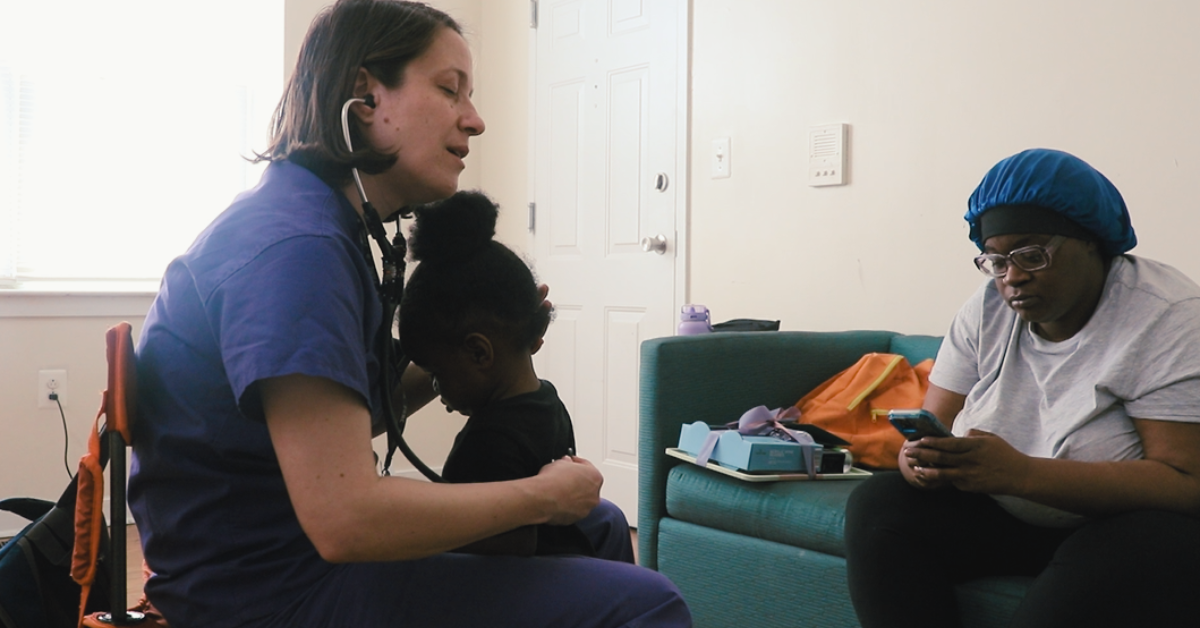
When most people think of holistic nursing care, they think of the “mind, body, spirit” model of care, and not necessarily of legal, transportation, and other social needs of patients. These needs are just as prevalent as physical health concerns in populations receiving community nursing care, and nurses who serve them are faced daily with clients who can’t attend health visits due to transportation, who can’t address their asthma because they can’t change their living conditions, or who have lost a job or housing opportunity due to discrimination.
The Family Advocacy and Integrated Resources Project (FAIR) supports nurses to refer home-visited families in Philadelphia for free legal counseling and complex case navigation. Additionally, the FAIR project can support families with emergency financial needs, such as a heater, replacement refrigerator, safe bed for their child, utility restoration fees, rent arrears, pest control, or transportation to medical and legal appointments.
In their usual line of work, nurses often find out about clients’ legal and case management needs, but are limited to a referral to community legal services, limited case management from a managed care organization, referrals to similarly overwhelmed social workers, or attempting to support families with case management or tangible resources themselves. The toll of trying to provide these additional resources contributes to nurse burnout. Nurses who feel personally responsible for attending to their clients’ many needs, who lack a sense of community, feel conflicting values, and are subject to work overload, are more prone to burnout.
Giving nurses an answer to those client needs they cannot attend to themselves gives them a sense of agency in what would otherwise be a recipe for moral distress. Moral distress is the internal conflict that arises when someone sees a problem that has a ‘right’ or moral solution but is unable to act due to a lack of knowledge or limitations on their resources or actions. Holistic care of the client gives nurses an answer to moral distress.
When a nurse is able to refer a client to free, trauma-informed legal services that can address their poor housing conditions, conflict with a landlord, discrimination at work or school, access to benefits, they are able to remove the burden of client needs that are outside their knowledge base and scope of practice, but which are necessary to the client’s health and well-being. When the nurse personally knows the provider of those services and can facilitate a warm introduction, where they can trust that the client’s needs will be met, it only increases the nurse’s ability to provide holistic care and reduces their risk of burnout. The FAIR project fulfills this need for multidisciplinary care for clients and reduces nurses’ moral distress.

On January 31st, 2024, our Nurse Advocacy Manager Joy Ahn led a number of Nurse Home Visitors and families in advocacy during the 2024 National Home Visiting Summit. The time spent before legislators included the personal stories of our nurses and the families they work with.
One family that joined Joy during the Summit was Janae Blakeley’s family, consisting of herself and her two sons. They spoke to representatives, explaining the impact the nurse home visitors and NNCC programs have had on their lives. Janae joined Mabel Morris Family Home Visit Program (Mabel Morris) when she had her second son. After visiting with legislators, Janae sat down with us to explain the impact nurse home visitors, and specifically her nurse’s work as a Community Clinic Systems Integration nurse with the Children’s Hospital of Philadelphia (CHOP), has had on her family. Read below:
I was referred to home visiting services by my primary care physician when I was pregnant with my first son, Haseer. I didn’t know much about home visiting before that but started working with a nurse and learning more. It was when I was pregnant with my second son, Khalif, that I received another referral from the Department of Human Services for Mabel Morris and started to see an immense impact the program had on my life. The Mabel Morris program has helped me and my sons in many distinct aspects of our lives - mentally, physically, and as a new mom navigating the parenting world.
In the beginning, I was incredibly nervous because I didn’t know what type of person the nurse would be. After meeting my first nurse for the first time in the Mabel Morris program, I was confident that the program would be able to help me. The nurse made me feel very comfortable about the program and she was incredibly informative. We set up family goals for my family, and I set up goals for myself and what I wanted to achieve while I completed the program. I have now had two nurses within the last three years, and they were both amazing. The nurses were beyond helpful to myself and my children. My current nurse even goes a step beyond our home visits because she works closely with my son's pediatric provider and is a part of his care team at CHOP to ensure that he gets the best care. I can’t say enough how grateful I am that God placed these nurses in my life and placed me in this program.

During this time in my son's life, I felt like I needed someone by my side through the medical process and that if I had another listening ear in the room, it would help. And when my nurse became a part of my care team, it did. I made my son's team aware that I had a nurse home visitor who works with CHOP, and she was either going to join the appointments or read all the notes and assist me with his care. I am beyond grateful, with every bone in my body, that my nurse and the Mabel Morris program came alongside me and his medical team and have been advocating for our healthcare.
These programs have assisted me in all aspects of my family’s lives, whether physically, mentally, or emotionally. I have faced challenge after challenge while I’ve been working with my nurses, and they’ve been with me every step of the way. I had instances of no running water, no electricity, and no heat. These were major events that impacted me and my children, and my nurses never stopped trying to help. They would go out of their way after hours to make sure my family was fine and protected. And the legal team has been amazing; they assisted me with my job, with the doctors, and even with my landlord. But the ultimate change in my life this program has given me is peace and comfort. I feel like the program is a part of my family. I truly believe anyone who joins this program and lets the nurses help them in the system will appreciate all that is done for them.
I don’t feel like I can pick a specific part of the program, I think the entire program is amazing. This program has given me so much assistance and help, I wouldn’t change one detail. The nurses, the mental health team, and the legal team - everyone is amazing. It’s a blessing and from me and my family, I thank you all for your help and support.

It’s never too early to think about the mental health of a child and their network of support. As a former Philadelphia Nurse-Family Partnership public health nurse home visitor, I got to join families’ parenting journey from pregnancy to their child turning 2 years old. As a nurse working with pregnant and parenting families, the gravity of my role in supporting families in shaping their developing child or children was not lost on me.
As a home visitor, I learned the value of building trusting relationships with families which allowed me to be a guide in exploring their many dimensions of health. The mental health of caregivers and their children always stood out to me. Child and family-serving providers have a unique opportunity to help families understand the connection between their mental health and the mental health of the children in their lives.
Infant and early childhood mental health includes how infants and young children develop the capacity to form safe and secure relationships, regulate and express emotions, and engage with their environment. Several factors can impede a child’s growth, development, behavior, and long-term mental health and well-being, such as poor nutrition, unstable or unsafe housing, or having a caregiver living with mental illness or substance dependency. Many children in Philadelphia are exposed to these and other circumstances like violence and discrimination that threaten their ability to grow optimally. Thankfully, there are strategies to alleviate and prevent negative health outcomes.
The impression that positive interactions and experiences leave in our lives is undeniable. They can counterbalance or outweigh negative experiences and build resilience. Positive interactions and experiences with caregivers and other caring adults can mitigate or prevent the impact of traumatic or adverse experiences. The community is also a part of shaping positive experiences in our lives. Embracing the African proverb “It takes a village to raise a child” can improve child and adult health outcomes. When caregivers and their children have access to quality programming and tangible tools and resources, their ability to care for themselves and the youngsters around them improves. I’m proud to be part of a community of providers working to support children and families by developing programming that builds the capacity of the people involved in children’s lives.
The National Nurse-Led Care Consortium (NNCC) and the Joseph J. Peter’s Institute (JJPI) are working on a new initiative to improve mental health outcomes among children in Philadelphia further. The program is called Philly SPROUT (Supporting Parenting Relationship through Outreach, Understanding & Training) and takes a generational and systems-level approach. Philly SPROUT will support children and their caregivers participating in NNCC’s home visiting programs, Nurse-Family Partnership (NFP) and Mabel Morris Family Home Visit Program (MM), through mental health services provided by JJPI mental health clinicians. The program will also enhance the capacity of Philadelphia-based child and family service providers through infant and early childhood mental health (IECMH) training and learning collaboratives.
Home visitors and other child and family-serving providers play a critical role in empowering families to build on their strengths and learn parenting and life skills that will support optimal child development. Philly SPROUT training offerings will be open to providers across multiple disciplines (child welfare, early intervention, early childhood education, and home visiting) and supply providers with additional tools to recognize and address the mental health needs of the children they serve. Our goal is to create a common language among the four sectors and highlight topics and interventions that positively affect children and their surrounding systems of support. Philadelphia child or family-serving providers interested in IECMH training offerings can view the NNCC website and click on the Training Tab for upcoming webinars or events.
This publication was made possible by Grant Award #1H79SM086431-01 from SAMHSA. Its contents are solely the responsibility of the authors and do not necessarily represent the official views of the SAMHSA.

Medicaid, a joint federal and state program that helps cover medical costs for some people with limited income and resources, provides coverage and care to 83 million low-income individuals across the United States, according to KFF. One in five people uses Medicaid, but particular populations are more likely to be covered through this program. Medicaid covers 41% of all births, almost half of children with special health care needs, and is key for individuals experiencing homelessness and those transitioning out of carceral settings.
Evidence shows that, “state Medicaid expansions to low-income adults are associated with increased access to care, increased economic security, improved self-reported health status, and other outcomes including increased early-stage cancer diagnosis rates, lower mortality rates for certain conditions (e.g., cancer, cardiovascular disease, liver disease), decreased maternal mortality, improved treatment management for conditions (e.g., diabetes, HIV), and improved outcomes related to substance use disorders.” Research also shows that children with access to Medicaid and CHIP, especially before the age of five, have better health outcomes throughout their lives.
It is clear that Medicaid benefits hundreds of thousands of people across the U.S., but sometimes, when we view these statistics, it is easy to view the impact happening elsewhere. We forget that these programs impact our friends, family, neighbors, and community. That’s why we asked our clients and community to share their stories on how Medicaid has impacted their lives. Read below:
When I was pregnant with my son, I didn't have health insurance. I could get it through my job, but they weren't answering my requests, and it was a lot of money anyway. That’s when I talked to my NFP nurse and a lawyer who helped me get Medicaid. I didn't go to the doctor until I had my card. When I went, I found out I was sick and my baby was not growing. I was immediately sent to the hospital, where they gave me medicine and checked my baby. He was born early, but he is healthy now. If I didn't have the insurance, I don't know what would have happened to me or my son.
I was pregnant with my first baby in 2024, and my husband was unemployed. During the first trimester of my pregnancy, I had severe morning sickness, a month of diarrhea with dehydration, and moderate vaginal bleeding. My friend with the same history of vaginal bleeding shared that she received a costly medical bill. That scared me. I went to the health center but was told I needed to wait, but if it was an emergency, I could go directly to the ER. The main problem was that I didn't have insurance, and I didn't have an income. How could I pay for the medical bill?
Because my medical condition was unbearable, I went to the ER. Thank God, and thank you to the social worker there who helped me apply to Medicaid. Medicaid helped me a lot through my difficult pregnancy, including covering the cost of the C-section and the breast pump as well. Now, Medicaid helps my baby receive good medical treatment. I hope Medicaid will be continued since it helps many people, including low-income families like my family.
Access to Medicaid has helped my family out so much. My daughter was born with bilateral sensorial hearing loss in both ears. She's had hearing aids since she was one, and they have helped her get access to hearing. She is doing amazing. If we lost [Medicaid] access, it would hurt her development.
Medicaid has helped me by providing essential health coverage when I may not have had access to affordable insurance otherwise. It has covered a range of medical services, including doctor visits, hospital care, prescription medications, and preventive treatments, helping me stay healthy without facing financial strain. This assistance has given me peace of mind, knowing that I can get the care I need when I need it most. If I don’t receive Medicaid, I am unsure how I will be able to keep up with the medical expenses for myself and my children.
Having Medicaid health insurance has affected me greatly. Without Medicaid, I would not be able to get healthcare for myself and my daughter. I would not have been covered for my labor and delivery, nor would I have received benefits that increase the health of my family such as breast pumps, gym memberships, food stamps, and other financial assistance.
Since becoming pregnant and becoming a mother, Medicaid has saved my health and my son’s health tremendously. With both of my pregnancies, I was enrolled in a home visiting program, first the Nurse-Family Partnership Program and then the Mabel Morris Program. I had severe preeclampsia with both pregnancies. In my first pregnancy, the severe preeclampsia was undiagnosed. My son and I almost died from it, and we had to get an emergency C-section. My son had to remain in the NICU for 3 additional months after his birth. Without Medicaid, I would NOT have been able to afford that hospital bill. My second pregnancy resulted in a stillbirth on March 22, 2023. Medicaid covered that hospital bill as well, and it allowed me to have space to grieve without having to worry about an outrageous hospital bill.
My son James has an extensive health record due to his premature birth. James currently has autism, has severe asthma, and has to see CHOP specialists. Recently, he was also diagnosed with a benign lesion (a noncancerous tumor) on his liver. CHOP believes he was born with that, and has to get monitoring every 6 months. James’ sleep studies at St. Christopher’s & CHOP, his asthma medications that cost $300 and up per inhaler, and his autism evaluation initially with the Center for Autism were all paid for by his Medicaid health insurance. Medicaid has been a lifesaver for me during my motherhood journey while I continue to work hard to finish college to provide a better life for my son and me.
As a first-time parent, Medicaid has helped us a lot. As a full-time mom without much savings, Medicaid was a lifesaver. Without it, I wouldn’t have been able to afford the hospital bills and treatments, and I would have avoided the hospital visits due to the high cost. Having Medicaid helped give my family peace of mind.
Medicaid benefited my child as well. My kid had some complications after birth, and he had to stay in the NICU for a few days. After the hospital stays, we had to make appointments with different specialists due to his condition. Through Medicaid, we were able to make all his appointments and checkups, and he is now a healthy, active toddler. I can’t imagine how the outcome would have been without the medical coverage.