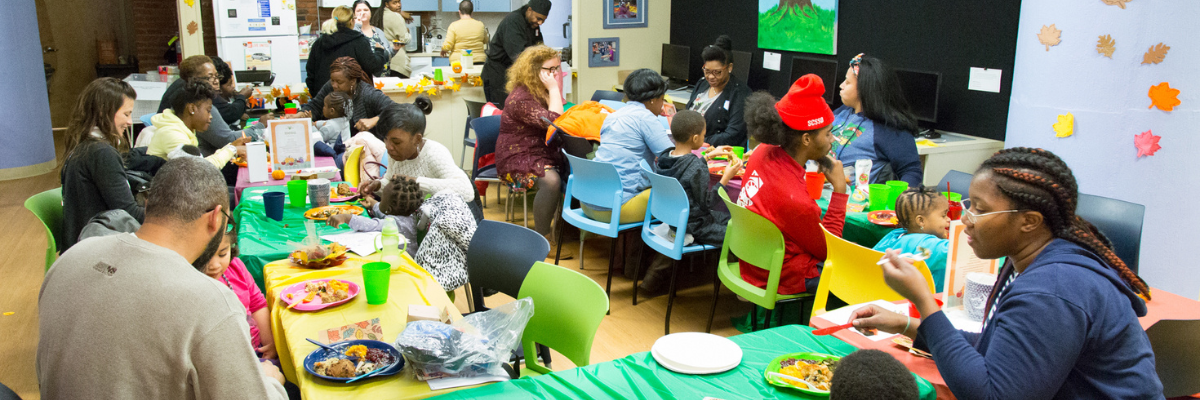
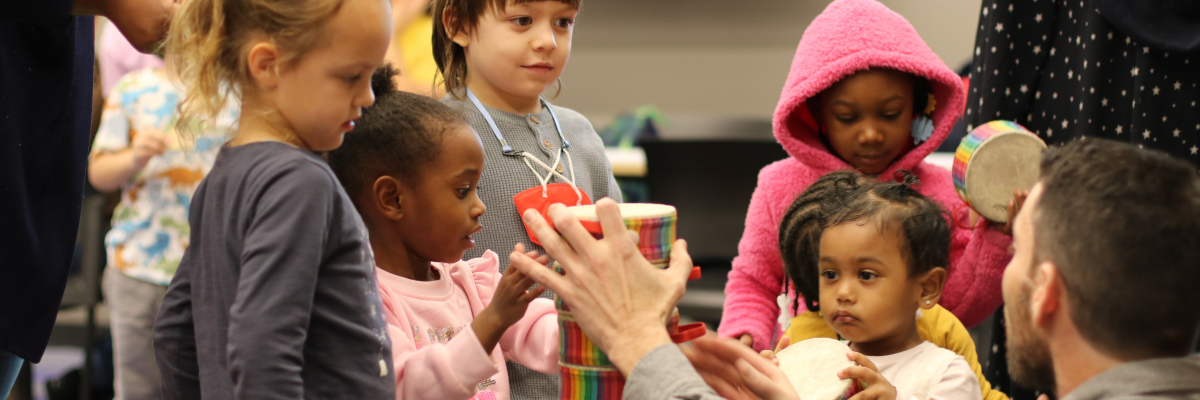
Each year our public health nurses host an annual end of the year meal for their clients. Started in 2014, this tradition celebrates the warmth and values of the season. It’s an opportunity to gather with families for a meal, look back at the year, take a family portrait, and create memories. We spoke with Lizz Tooher, Senior Director of Child Health and Education, who began her career at NNCC as a nurse with Mabel Morris over 11 years ago. Read the interview below:
Can you tell us about the start of the End-of-Year Bash?
Of course. Actually, this is the first time we called it an End-of-Year Bash. Historically it's been an end of year meal, but as our team has grown and we have an event coordinator, the event grew alongside it. This specific event started two years after Mabel Morris began. We already held monthly events called Group Connections, created to build community and reduce isolation. But we wanted something special for the end of the year, to celebrate the warmth and value of the holiday spirit. So for our first End-of-Year Bash we planned an evening meal for the families.
The event started as preparing a meal together. The families and nurses all came together to make a large meal, then adults sat together at the large table to eat as the kids and nurses shared their meals over some activities. And it was successful.

How did the meal grow to be the End-of-Year Bash?
Eventually, as our program and budget grew, we brought on more nurses and families. The event became too large to have the input of all the families to cook, but we didn’t want to create an entirely new event, so we shifted gears. We learned from the feedback of our families and our own experiences how to best accommodate families during the End-of-Year Bash.
We incorporated music and dancing, story time and family photos. Our families started bringing friends and extended family to participate, involving more of their community than they are able to do during home visits. And at the end, the families leave with a goodie bag of snacks, a book, and something commemorative.
This transition reflected in the Bash - a lot has changed. Initially we had a strict structure during the event, but then we learned that it needed to be an open house and be more flexible. We learned from what we were seeing - building expertise over time. Like everything else in our work, it's long term with families. You get to know your work better and the events better. It’s much less formal now.
How does this Bash illustrate how nurses are treating the whole person when it comes to their work with their families. For us, the care starts before the families arrive to the event. If you go to the doctor, the care starts in the exam room, but for us we start before with the emphasis of providing rides and food. We understood that barriers existed for these families that impacted their attendance. Our care begins before the event does - we provide free transportation, free food at any time during the event, and a safe space for families to enjoy the festive season. And, as mentioned before, a huge part of our model is about building community and reducing isolation. This event brings families together. Folks come when they can, and we want to meet them where they're at. Why is this End-of-Year Bash so meaningful to both nurses and their families? These events bring moments out for families - they spend time with their nurses and realize they aren't ready to graduate from the program. These families and nurses care so much about the relationships they've spent years forming. Learn more about our public health nursing programs. 
LATEST NEWS
STAY CONNECTED TO NURSE-LED CARE
The National Nurse-Led Care Consortium is proud to announce that it is one of 80 organizations to receive a Public Health AmeriCorps program grant to support the recruitment, training, and development of a new generation of public health leaders.
This new partnership with AmeriCorps, the federal agency for national service and volunteerism, and the Centers for Disease Control and Prevention will help meet public health needs of local communities by providing surge capacity and support while also creating pathways to public health-related careers. Public Health AmeriCorps programs will support health equity, mental health and substance use disorders, COVID-19 recovery, and will increase access to services, especially in underserved communities.
NNCC has been awarded funding to host a Public Health AmeriCorps program unique to its mission. The AmeriCorps Public Health Nursing Fellowship will provide undergraduate nursing students with community based primary care and public health clinical experiences serving vulnerable communities. This prestigious fellowship will enhance students’ competencies to screen patients for structural determinants of health, refer individuals to social and healthcare services, provide healthcare education to high-risk patients, and expand capacity within primary care and public health organizations.
During the fellowship, students will receive advanced training and professional development opportunities along with a living stipend. Upon the completion of the program, students will also receive an education award which can be used for current or future school expenses.
Are you a nursing student interested in participating in the AmeriCorps Public Health Nursing Fellowship? Fill out our Nursing Student Interest Form and see further details here.
If you are interested in hosting an AmeriCorps member at your organization, contact Christine Simon, Director of Workforce Development, at .
Click here to learn more about NNCC's AmeriCorps Programs
Click here to apply for open AmeriCorps State positions
The Pennsylvania Action Coalition (PA-AC), a program of the National Nurse-Led Care Consortium (NNCC), is thrilled to announce their new collaboration with the Geisinger School of Nursing to address nursing faculty and instructor shortages by creating Nurse Education, Practice, Quality, and Retention Clinical Faculty and Preceptor Academies (NEPQR-CFPAs). The collaborative will execute the program with funds awarded by the U.S Health Resources and Services Administration (HRSA), CDFA#93.359.
The purpose of the NEPQR-CFPA is to take steps to fill the faculty/instructor gap in schools of nursing and increase nursing workforce retention by leveraging staff nurses to participate as skilled preceptors and clinical instructors. The PA-AC and Geisinger, alongside numerous academic and health system partners, will build academic-clinical-community partnerships that develop and implement comprehensive and self-guided nurse education training curricula. The project will focus on HHS Region 3 (including Delaware, Maryland, Pennsylvania, Virginia, West Virginia, and Washington, D.C) to build a formal nurse education training curriculum to train clinical faculty and preceptors.
To develop this curriculum, the PA-AC will assemble an Advisory Board that is reflective of diverse practice areas, academic pathways, geographic location, and populations served. The advisory board will oversee curriculum development and determine metrics for review. The PA-AC will work with Advisory Board stakeholders to ensure that the course content is engaging, thoughtfully articulated, and caters to a wide audience. In Year Two of the project, Geisinger employees across the health system will pilot and evaluate the curriculum. The Advisory Board will use lesson learns to prepare the program for implementation across HHS Region 3 in Year Three.
The PA-AC will work with the Advisory Board and its extensive network to foster dialogue around the program’s goals and outcomes, promote the implementation of the program, and showcase the project as a model to bolster the nursing workforce. Ultimately, the purpose of the collaboration is to work across the region to improve the training, preparation, and availability of clinical nursing faculty and preceptors to better support nurses in advancing healthcare.
The PA-AC is currently recruiting members of the NEPQR-CFPA Advisory Board that are reflective of diverse practice areas, academic pathways, geographic locations, and populations served in HHS Region 3. You can apply to become a member here. Please reach out to Jennifer (Horn) Gimbel, Director of the PA-AC, at with any questions.
This week, National Nurse-Led Care Consortium staff will be meeting with colleagues to advance equitable care for health center patients at a conference in Fort Lauderdale, FL. We believe that now more than ever, it’s important to convene with our colleagues to share innovations in care for underserved communities. However, we can’t do this in Florida without acknowledging the unique challenges LGBTQ+ patients often face accessing care in the state.
NNCC’s mission is to advance nurse-led healthcare through policy, consultation, and programs to reduce health disparities and meet people’s primary care and wellness needs, a goal that cannot be met without access to inclusive and safe health care services for the transgender and gender-diverse community. As part of our participation in this health center conference, we want to reiterate our commitment to equitable, gender-affirming care and are making a $500 donation to Care Resource, a 501(c)(3) nonprofit organization and a Federally Qualified Health Center (FQHC) with four locations in Florida. Care Resource provides compassionate, competent, and committed healthcare and support services to address the full health care needs of their pediatric, adolescent, and adult populations, and their health centers are uniquely positioned to assist transgender, genderqueer, and gender-diverse individuals with their health care management needs.
We will continue to explore ways we can offer support to LGBTQ+ people living in areas with restricted access to care, and we encourage our fellow health center networks to do the same as we prepare to gather in Florida.
Click here for more information on Care Resource.

NNCC is proud to announce that Shukriyyah Mitchell Hinton, our Senior Director of Outreach and Advocacy, has been named a 2022 Visionary Leader by the Valentine Foundation. The Visionary Leadership Fund, managed by the Valentine Foundation, is “committed to advancing, encouraging, and developing visionary leadership skills in both emerging and executive-level women nonprofit leaders.” Mitchell Hinton will use this grant award to enroll in Cornell University’s Women in Leadership certificate.
Shukriyyah Mitchell Hinton is a public health nurse who has served clients, coworkers, and local communities with NNCC for over a decade. Last year, she joined the NNCC senior leadership team as Senior Director of Outreach and Advocacy, where she supports advocacy work that addresses structural issues facing nurses, NNCC clients, and their families. Of this award, she says:
This funding will allow Mitchell Hinton to bring new leadership strategies and initiatives back to NNCC while supporting her personal goals. NNCC Executive Director and Visionary Leader nominator Sarah Hexem Hubbard shares, “Shukriyyah is one of those natural leaders who inspires others and fosters an environment where everyone—clients, community members, colleagues—feels heard. This award is a further investment in her capacity to affect meaningful change on behalf of NNCC and the communities we serve.”
You can read more about the Visionary Leadership Fund and this year’s list of Visionary Leaders here. To learn more about Shukriyyah Mitchell Hinton’s role at NNCC, check out our Policy Blog.