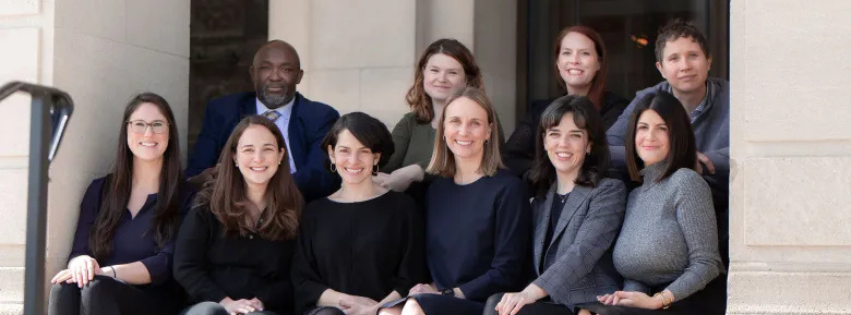
In 2016, NNCC launched the Nursing-Legal Partnership within its nurse home visiting services, building on its national work supporting medical-legal partnerships and community nursing.
Aligning Community Nursing and Integrated Legal Aid
At a national level, NNCC worked to add nursing voices to the larger conversation on Medical-Legal Partnership (MLP), an upstream intervention that integrates civil legal aid into health care settings to address health-harming legal needs. In 2013, NNCC received a grant from the Kresge Foundation to support Nurse-Led MLPs, including one started locally at Abbottsford Falls in partnership with the Legal Clinic for the Disabled. Around the same time, PHMC worked with nursing leadership at Rising Sun Health Center in the Olney area of Philadelphia to bring a partnership with Community Legal Services to fruition. Nationally, NNCC supported MLPs at East Tennessee State University and University of Akron, building upon the national alignment between community-based nursing and the public health opportunity presented by the MLP model.
Back in Philadelphia, NNCC began the work of bringing direct legal services to its own home visiting programs. In 2016, NNCC partnered with HELP: MLP at Widener University to develop a Nursing-Legal Partnership to serve families participating in NNCC’s maternal and child health home visiting programs. Since its inception, NNCC and HELP: MLP have refined their model and expanded their provision of services to better meet the needs of families. Between 2016 and 2022, the Nursing-Legal Partnership received support from the Hillman Foundation Innovations in Care program, designed to identify promising nursing models that address social determinants of health, as well as the Oak Foundation, an international philanthropy focused on the intersection of health and housing.
NNCC also received two consecutive grants from Pennsylvania’s Children’s Trust Fund to build the evidence base for integrated legal services as a strategy to reduce parental stress and therefore risk of child abuse and neglect. Through these investments, the Nursing-Legal Partnership received national attention and was ultimately recognized as an evidence-informed practice by the Pennsylvania Office of Child Development and Early Learning.
The start of NLP was focused on evaluation, data collection, and service delivery. The program focused on training nurses to screen for unmet legal needs among their client population and then, together with the team from Widener, deliver free legal services to improve client health. They helped with public benefits matters-- TANF, Food Stamps, Medicaid, and SSI cases; housing conditions and evictions; employment accommodations; and other legal matters that could improve clients' health.
Layering in Resources to Address Concrete Needs
There were, and still are, systems in place to help families, but many of them created a huge burden on our clients and home visitors, even with a legal team to help. Financial aid through organizations like DHS or PECO required so much paperwork and documentation that the work felt insurmountable. And when those funds ran out, families were often left with no help. In 2018, DHS announced an overabundance of funds and opened them to more programs, but the documentation load still sat on individuals. This sparked an idea: what if NNCC could provide emergency funds for our clients without requiring the immense and strict paperwork?
Starting with a small amount of seed funding available through varied COVID-19 relief efforts, the team created and managed an internal referral system. Although the pilot only served a limited number of NNCC clients, it was a success. Clients could access funds in emergencies, and home visitors could help their families with reduced documentation and process burdens.
Family Advocacy and Integrated Resources (FAIR)
In 2022, the William Penn Foundation invested in a strategy to scale both the Nursing-Legal Partnership and what is now called the Family Support Fund to all maternal child health home visiting agencies in Philadelphia. HELP: MLP worked with NNCC to establish the Family Advocacy and Integrated Resources (FAIR) Project, which leverages the strength of maternal child health home visiting through two complementary but distinct approaches: (1) legal services to navigate structural determinants of health delivered by the FAIR legal team and (2) rapid financial relief for families through the Family Support Fund. Since February 2023, the FAIR Project has completed 3,225 screenings for unmet housing needs, and more than 2,700 housing-related legal cases have been resolved for 1,254 unique participants.
Take a look at how NNCC has grown since the FAIR Project, and at our goals for the future.
Learn how you can support the FAIR Project through a donation here.

