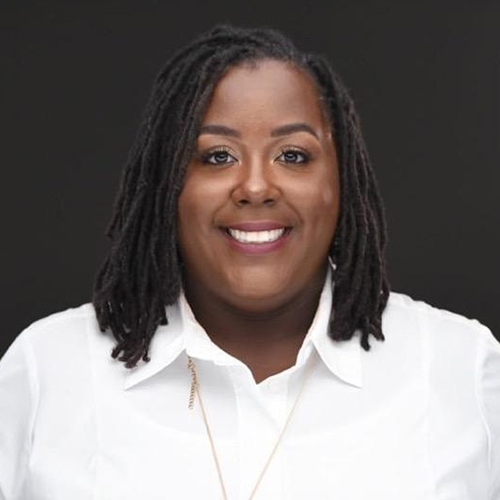
The National Nurse-Led Care Consortium (NNCC) recently created four new Senior Director roles to advance our mission to strengthen communities through nurse-led care. I sat down with Shukriyyah Mitchell-Hinton, BSN, RN, NNCC’s new Senior Director of Outreach and Advocacy, to discuss her role and the future of nurse-led care.
Hi Shukriyyah. Thanks for talking to us today. Tell us about yourself! What led you to this position?
I have been a public health nurse for over 11 years. I graduated from the University of Pennsylvania School of Nursing and started my first nursing job as a Nurse Home Visitor for the Philadelphia Nurse-Family Partnership at NNCC. For six years, I worked directly with families in Philadelphia who were expecting their first child. The exposure to incredibly resilient families with challenging circumstances is something that will always stick with me. For the past five years, I have been supporting the practice of other Nurse Home Visitors as a Nursing Supervisor. Just a few short months ago, I accepted the position of Senior Director of Outreach and Advocacy. The position really feels like a good fit and an organic progression. It feels really rewarding to translate what I experienced in the field into systems level change.
What do you envision as the purpose of your new role as Senior Director of Outreach and Advocacy?
My purpose is to support advocacy work that translates what I saw in the field into real life policy changes. Underrepresented families experience challenges not because they are unlucky, but because the structures in place have left them vulnerable. I see my mission as addressing the structural determinants of health through advocacy and policy work with some incredibly talented folks. I have the pleasure of working with people who have been doing the work already. Simply put, I want to work beside them and envision new ways to approach change together.
How does your background as a nurse influence the way you approach advocacy?
Being a public health nurse is the only nursing that I truly know. Working in the public health sphere has shown me that all people want are healthy and thriving families. To me, nursing is not about being the smartest person in the room, but about asking the right questions. As a nurse, I see myself as an investigator. I approach advocacy with the same mindset. My question has always been, “How do we support this family (and all families) to be their best? What are the barriers that are keeping this family from thriving?”
Has the importance of outreach and advocacy changed since onset of the COVID-19 pandemic? How?
Yes, it has. The pandemic has magnified the challenges of people already underrepresented. COVID has highlighted issues with access to equitable healthcare, income supports, safe housing, quality education, and more. Vulnerable families were not positioned to immediately pivot once the pandemic arrived. The pandemic has emphasized the need for structural changes to be made in the way we treat our most vulnerable. Our advocacy needs to be about freeing resources and changing policies so that everyone has the access that they need to thrive.
What does nurse-led care mean to you?
Nurse-led care means putting nurses at the helm working with multidisciplinary teams. Nurses are highly trusted professionals that view healthcare in a holistic manner. Nurse-led care is not limited to treating patients in the hospital and making decisions there, but also in the board room and where policies are made. Nurse-led care means elevating nurses in all the places that decisions are made and trusting them with the authority to lead.
Shukriyyah Mitchell-Hinton, BSN, RN is the Senior Director of Outreach and Advocacy at the National Nurse-Led Care Consortium.
Last week, the National Nurse-Led Care Consortium (NNCC) joined 151 other organizations in voicing our support for the Public Health Funding Prevents Pandemics Act, a bill to restore funding to the Prevention and Public Health Fund (PPHF). The bill recognizes the effectiveness of preventative public health measures both in reducing disease and death and in providing cost savings within the healthcare system.
Introduced by Senator Richard Blumenthal and Representative Doris Matsui, the bill would restore $2 billion in funding to the PPHF for this and subsequent years. The letter states that its passage would "strengthen our nation’s ability to develop innovative programs that can respond to new or existing infectious disease threats, help reduce the burden of chronic disease, and enable Americans to live longer, healthier lives."
You can read the full letter below.
On February 25, the National Nurse-Led Care Consortiuam joined 58 other nursing organizations as part of the Nursing Community Coalition in a letter to Congress outlining our nursing workforce priorities for the next COVID-19 relief package. These priorities include increasing support for our public health nursing workforce, allocating resources for front line workers, including mental health care and childcare support, expanding Title VIII nursing workforce funding, and promoting access to telehealth care.
We will continue to push for increased support for nurses throughout the pandemic and beyond. You can read our full ask to Congressional leadership below.

This Black History Month, I am celebrating the life of Mabel Harmon Morris, for whom NNCC’s Mabel Morris Family Home Visit Program is named. She was born in 1921 in Chincoteague, Virginia and died in 2009, at the age of 88. I had the privilege and pleasure to be in her presence in the big 90’s when I was a Community Health Outreach Worker at The La Salle Neighborhood Nursing Center and she was a Professor at the La Salle University School of Nursing.
Mabel was a powerhouse, working alongside Philadelphia Nurse Family Partnership founder Dr. Kay Kinsey, Dr. Patty Gerrity, and Dr. Gloria Donnelly, the Director of the School of Nursing at La Salle University. It was at this time and place where the conception of public health nurse home visiting as we know it began. Mabel would arrive to a meeting early, taking a seat of power and armed with a briefcase full of data — ready to argue, debate, and perfect public health policy as it pertained to underserved families in our city.
Mabel had silver hair and gold glasses. She dressed in rich materials with expert tailoring. She had a serious, no-nonsense expression, and her language was articulate as she fought for policy and procedure that would make a difference in the lives of the community. Undaunted by any government, city official, legislator, or community stakeholder, she stood her ground and made her point. Mabel ensured that everyone around the table could respectfully agree to disagree. She often hurried the group to craft solutions and get to the bottom line, because she had another meeting to attend. Mabel would not allow anyone to let their privilege or politics color an outcome for the families she served.
For her part, Mabel never forgot her humble beginnings. She was born to a 14-year-old mother, Flossie, who saw, respected, and nurtured Mabel's intellectual and academic growth. It was her mother who encouraged her to pursue nursing as a career — a career that contained many academic and professional accomplishments. Mabel attended the Philadelphia High School for Girls and went on to graduate from Mercy Hospital and School for Nurses in 1943. She received her BSN in 1958, and in 1964 she received her Masters in Public Health Nursing Administration from the School of Public Health and Teachers College at Columbia University. Throughout her career she was active in many professional associations, provided expertise as a consultant, and published and presented research across the country. Her papers are now archived at The University of Pennsylvania’s Barbara Bates Center.
Mabel’s vision allowed her to see families both where they were and where they could be — she saw their potential to grow, develop, and overcome hardships. She fought to remove barriers and create programs and policy to enrich and heal the community. I am proud that the Mabel Morris Home Visit Program is operating in her spirit, and that our nurses continue to support families to their full potential.
Valerie Holloman is an Outreach Specialist and Resource Navigator for the Philadelphia Nurse Family Partnership and Mabel Morris Family Home Visit Program at the National Nurse-Led Care Consortium.
On February 12, the National Nurse-Led Care Consortium (NNCC) joined 315 other leading health and public health organizations in calling on Congress to allocate $4.5 billion more long term, annual funding to create and sustain critical public health infrastructure. Recognizing that short-term, supplemental funding will not be sufficient to combat the pandemic or to prepare the US health workforce for our next public health emergency, advocates outlined a plan for a large, sustained investment in the next COVID-19 relief package. Funds would be used for epidemiology, policies and programs that increase health equity, disease surveillance, emergency preparedness, and community partnership development.
NNCC will continue to advocate for policies and funding that strengthen the public health and nursing workforces, ensuring that we can continue the important work of reducing health inequity and protecting the nation's health. You can read the full letter below.